

(Zaragoza, Tuesday, 25 August 2026). What happens to animals when daylight suddenly fades for several minutes? Researchers from the universities of Zaragoza and Salamanca monitored the activity and physiological parameters of sheep, chickens and equids during the total solar eclipse of 12 August 2026 to investigate its effects on these animals. Although the results are still preliminary, they show that the animals exhibited changes coinciding with the eclipse, although not all individuals responded in the same way, nor did the changes necessarily occur during the brief period of totality itself.
In Zaragoza, a team from the Aragon University Research Institute for Environmental Sciences (IUCA), led by Alfonso Abecia, monitored ten sheep using accelerometers over a six-day period. Five of the sheep also carried biologgers that recorded body temperature, heart rate and heart rate variability every two minutes. Each animal served as its own reference, with measurements from 12 August compared with those recorded at the same times on five other days.
The sheep showed a collective reduction in activity in the minutes immediately before and around totality. All ten animals exhibited a temporary collective decrease in activity around the maximum phase of the eclipse. Between 20:24 and 20:28, mean activity fell by approximately 40% compared with the reference days, and during the following minutes, nine of the ten sheep remained less active than usual for that time of day. By contrast, the physiological responses of the five sheep fitted with biologgers were much more individual: some showed a decrease in heart rate, while others showed an increase, and no common pattern in body temperature emerged. The eclipse therefore coincided with a relatively coordinated behavioural change within the flock, whereas each animal’s internal physiological response was more variable.
The combination of these two findings is particularly interesting: the group’s behaviour showed a relatively coordinated change, while the animals’ internal physiological responses were far more individual.
“The sensors allow us to observe something that would be almost impossible to detect with the naked eye. We are not simply asking whether an animal moved or remained still during totality. We can reconstruct minute by minute what it was doing before, during and after the event, and in some animals simultaneously observe changes in heart activity and body temperature,” explains Alfonso Abecia, Director of the Aragon University Research Institute for Environmental Sciences (IUCA) and head of the experiments conducted in Zaragoza.
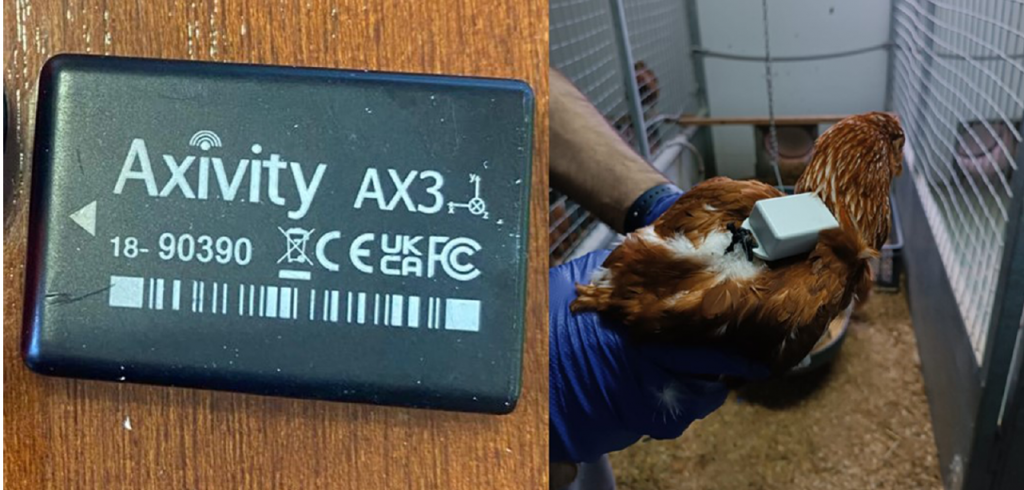
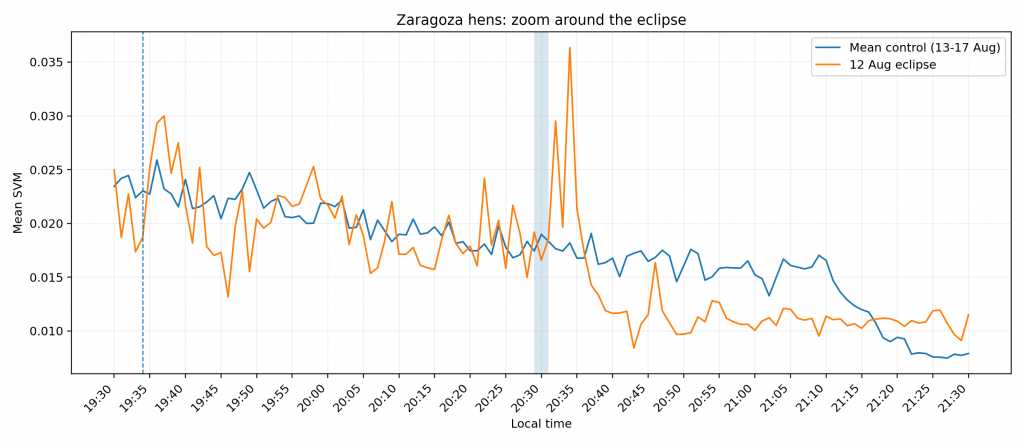
The researchers also studied 16 chickens at the Faculty of Veterinary Medicine in Zaragoza using accelerometers. The eclipse did not reduce their overall level of activity during the day, but it clearly altered how that activity was distributed over time. Following totality, the chickens temporarily reduced their movement, particularly between 20:40 and 20:59. They also began this transition earlier than on normal days, with a median advance of around 18 minutes. Their subsequent recovery in activity was also delayed. The eclipse therefore did not cause the chickens to move less throughout the entire day, but instead substantially altered when their activity occurred and when they began to behave as though nightfall were approaching.
Experiments were also conducted in collaboration with the University of Salamanca, led by Professor Carlos Palacios Riocerezo, from the University of Salamanca’s Animal Production area.
In Burgos, six chickens monitored using accelerometers showed one of the clearest behavioural patterns. Five of them began their evening transition towards night-like activity approximately 40 to 60 minutes earlier than usual. Following totality, between 20:45 and 21:19, all six showed lower activity than would normally be expected at that time.
Additional sensors fitted to chickens in Burgos made it possible to study heart rate and body temperature. Analyses conducted so far indicate a post-eclipse slowing of heart rate in all six birds studied. The decrease in heart rate was stronger and more prolonged on 12 August. This finding is being examined particularly closely because it allows researchers to compare the response with the normal progression observed during an evening without an eclipse.
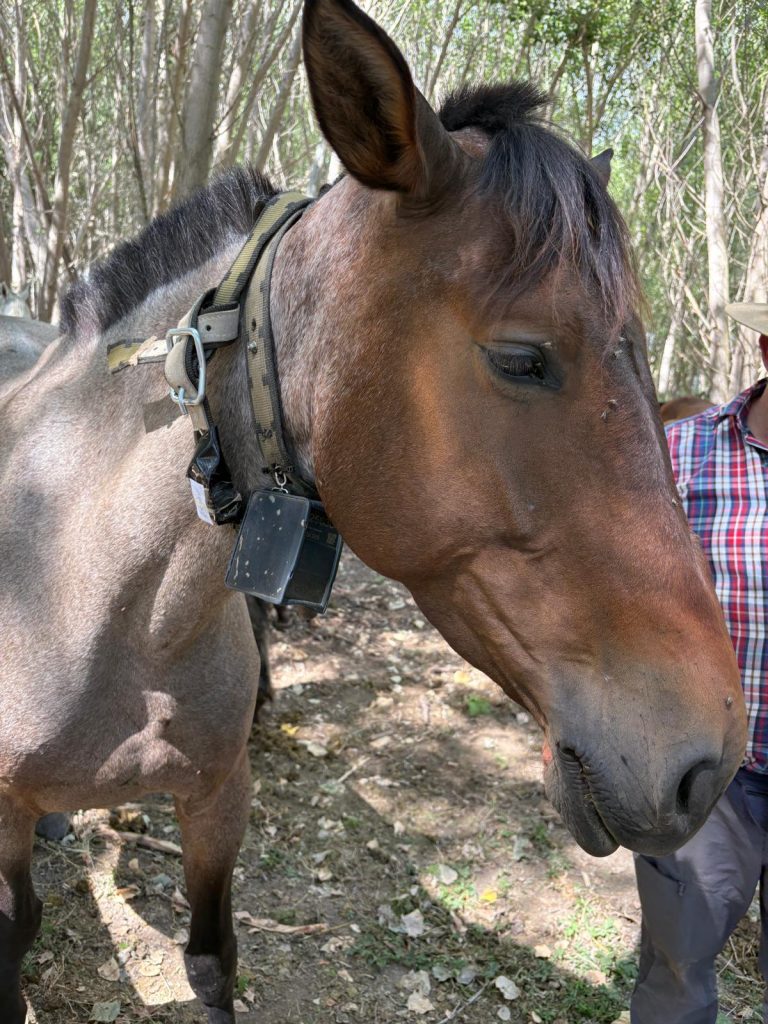
The third study site was the Cañizar Wetland, between the towns of Cella and Villarquemado, in Teruel. There, with the collaboration of Asociación La Dula, five equids were monitored using accelerometers, and their activity on the day of the eclipse was compared with that recorded over nine reference days.
The monitored mares, mule and donkey showed very different individual responses immediately after totality. Some animals increased their activity, while others reduced it. A common pattern emerged later, however. Between 21:20 and 21:39, all five animals were less active than they had been at the same time on the reference days. Mean activity was reduced by 18.6%.
One of the animals at the centre of the study was a female donkey monitored at the Cañizar Wetland, which was simultaneously fitted with an accelerometer and a biologger. This made it possible to observe both her behaviour and what was occurring physiologically at the same time. Her response was complex. Before totality, she briefly reduced her activity. Afterwards, she began moving again and even exceeded her usual activity levels. At the same time, her heart rate rose from 46 beats per minute at 20:25 to approximately 60–63 beats per minute during and after totality. Her body temperature remained almost unchanged.
Taken together, the experiments are beginning to reveal a considerably more complex picture than the popular assumption that animals simply mistake an eclipse for the onset of night. In some species, activity decreases. In others, the temporal organisation of behaviour changes. Some animals respond immediately, while others take tens of minutes to do so. Significant differences can even be observed between individuals of the same species.
The researchers believe that one of the most interesting questions will be determining which environmental cue triggers each response. The eclipse caused an exceptionally rapid decrease in light levels, but it also altered other environmental conditions and occurred very close to natural sunset.
For this reason, the research team is careful not to conclude that all the observed changes were directly caused by the eclipse. A fundamental part of the study involves comparing each animal’s behaviour with its behaviour at the same time on other days and identifying changes that are exceptional relative to its normal activity patterns.
The study therefore brings together data collected by the IUCA team at the University of Zaragoza, research conducted in Burgos in collaboration with the University of Salamanca under the direction of Carlos Palacios, and the monitoring of equids at the Cañizar Wetland, carried out with the collaboration of Asociación La Dula.
The analyses will now continue by integrating data across species, locations, activity patterns and physiological responses. The ultimate aim is to determine whether, despite highly diverse individual responses, there is a common underlying feature: that an environmental disturbance lasting only a few minutes was sufficient to temporarily alter the organisation of behaviour in some animals.