
(Zaragoza, Tuesday, 1 September 2026). Research carried out this summer at Aguilón P5 Cave (Zaragoza) has provided further insights into the last Neanderthal populations of Aragon. Findings from the latest fieldwork campaign, conducted in July, are helping researchers to establish more precisely the chronology and way of life of the human occupations documented in the cave around 40,000 years ago. The site also preserves evidence of earlier occupations, indicating repeated human presence throughout the Middle Palaeolithic.
The main objective of this summer’s excavations was to define more precisely the occupation area located at the entrance to the cave. The research team recovered new Mousterian lithic tools made from exceptionally high-quality flint, sourced from outcrops in the area around Botorrita. These finds provide new evidence on the procurement and mobility strategies of the Neanderthal groups that occupied the cave.
“Aguilón P5 offers us an exceptional opportunity to understand the last Neanderthal communities to inhabit Aragon. Each new phase of research allows us to reconstruct more precisely when they lived, how they organised themselves and the environments in which they carried out their activities,” explains Marta Alcolea, scientific co-director of the project and lecturer in the Department of Ancient Studies at the University of Zaragoza.
One of the main lines of research pursued over the past year has focused on refining the site’s chronological frameworkthrough new dating analyses and geoarchaeological studies, supported by a project funded by the Palarq Foundation. The results are helping to refine the chronological sequence of human occupation in the cave and further highlight the importance of Aguilón P5 for understanding the last documented Neanderthal occupations in Aragon, around 40,000 years before present.
“Defining the occupation areas and analysing the newly recovered tools are helping us to better understand how Neanderthals organised their activities and made use of the resources available in the surrounding landscape,” says Carlos Mazo, Professor of Prehistory and scientific co-director of the project.
The project combines archaeological excavations with chronological, technological and palaeoenvironmental studiesto gradually reconstruct the process that led to the disappearance of Neanderthals in the Ebro Valley. It is led by Carlos Mazo and Marta Alcolea, lecturers at the University of Zaragoza and researchers with the First Settlers and Archaeological Heritage of the Ebro Valley research group (P3A) at the Aragon University Research Institute for Environmental Sciences (IUCA).
Reconstructing the environment in which they lived
Research at Aguilón P5 continues well beyond the excavation campaigns. Throughout the year, specialised studies are carried out on materials recovered both during the latest fieldwork and in previous campaigns, with the aim of reconstructing, from different disciplinary perspectives, the human occupations of the cave and the environmental conditions recorded there.
Among these studies is the first systematic analysis of the micromammals from Aguilón P5 Cave, conducted by Alodia Villellas as part of her Master’s thesis for the University of Zaragoza’s Master’s Degree in the Ancient World and Archaeological Heritage. The study was co-supervised by Dr Julia Galán, head of the Quaternary Micromammal Palaeobiology Section at the Senckenberg Society for Nature Research (Germany). Its findings will contribute to reconstructing the environmental conditions in which the region’s last Neanderthal populations lived.
Training and research at a key archaeological site
This summer’s fieldwork campaign involved scientific directors Carlos Mazo and Marta Alcolea; laboratory technician Rafael Laborda; Master’s students Marta Rubio, Alodia Villellas and Alejandra Moreno; and undergraduate students Irene Boira and Rebeca Gracia, the latter participating through the internship agreement between the University of Zaragoza and UNIVERSA.
The fieldwork was authorised by the Directorate-General for Cultural Heritage of the Government of Aragon and funded by Aguilón Town Council. The project aimed at refining the site’s chronological framework is supported by the Palarq Foundation, while the research is being conducted by the University of Zaragoza in collaboration with a range of national and international institutions.
The results obtained over the past year confirm the considerable scientific potential of Aguilón P5 Cave. The combination of systematic excavations, new dating evidence and multidisciplinary studies is advancing the characterisation of the last Neanderthal occupations in Aragon and establishing the site as one of the most promising archaeological records in the inland areas of the northeastern Iberian Peninsula for investigating the transition between the last Neanderthals and the earliest Homo sapiens populations.
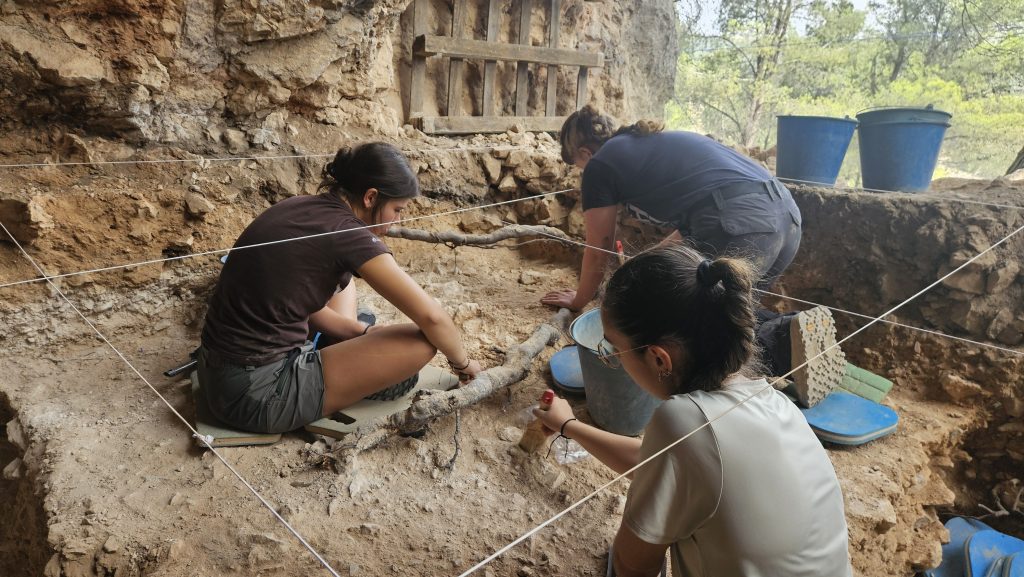
Photo caption: Students from the University of Zaragoza during the excavation of a Mousterian occupation layer at Aguilón P5 Cave.