

(Zaragoza, Tuesday, 17 March 2026). The journal Nature Communications has recently published an international study involving researchers from the University of Zaragoza, whose findings point to the existence of bird exchange networks linking tropical forests, highland plateaus and coastal deserts from the Amazon to the Andean coast before the rise of the Inca Empire. The study provides evidence that more than 800 years ago, Amazonian parrots—including several species of macaws—were captured in the rainforest and transported alive across the Andes to the Peruvian coast.
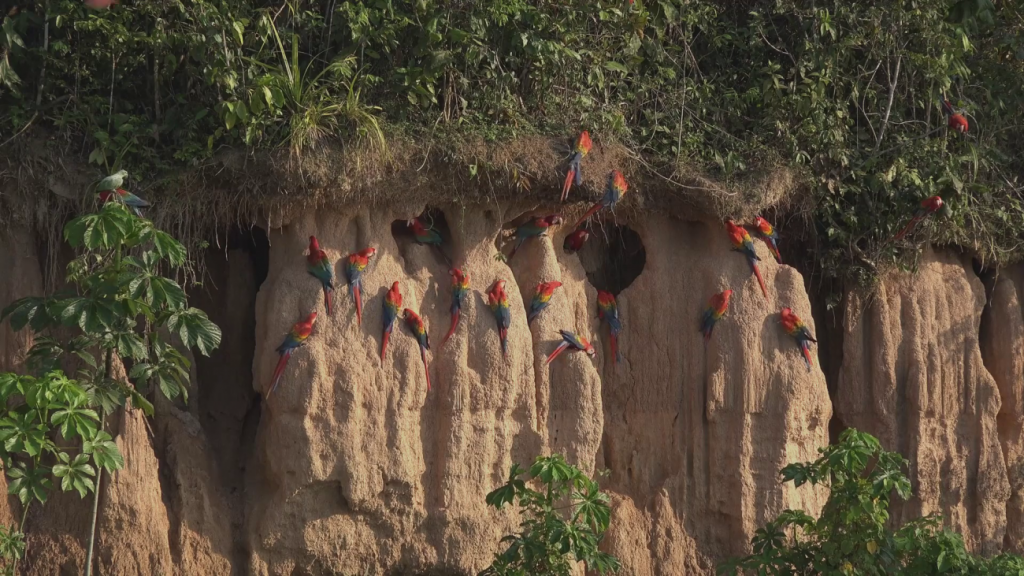
The research analyses macaw feathers discovered in Pachacamac, one of the most important religious centres of the ancient Andean world. The international research team, led by George Olah from the Australian National University (ANU) and ARAID researcher Pere Bover, head of the Paleogenomics Laboratory at the University Institute for Environmental Sciences of Aragón at the University of Zaragoza (IUCA-Unizar), also includes researchers from the University of Adelaide (Australia), the Antonio Ruiz de Montoya University (Peru) and Southern Illinois University (USA).
Since its publication last week, the study has attracted considerable international attention. According to Altmetric data, which track the online impact of scientific publications, the article ranks among the top 1% of scientific papers receiving the greatest attention since publication, both among studies of the same age and among articles published in Nature Communications. It also falls within the top 5% of research outputs with the highest overall attention tracked by the platform, with more than fifty appearances in media outlets worldwide and numerous mentions and interactions across social media.
Ancient DNA reveals the origin of the feathers found in Pachacamac
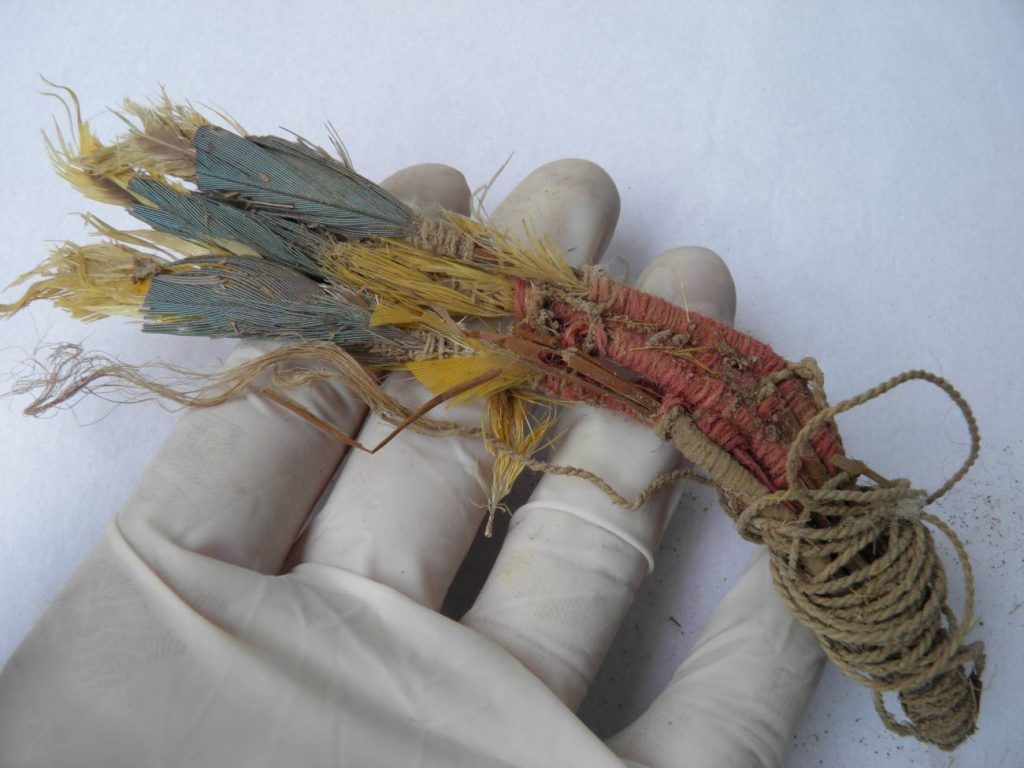
The story of this study begins in Pachacamac, one of the most important religious centres of ancient Peru, located on the central coast near present-day Lima. In 2005, an archaeological excavation uncovered an intact tomb belonging to the Ychsma culture (AD 1000–1470), which dominated this region before the expansion of the Inca Empire.
Inside the funerary chamber, archaeologists discovered 34 funerary bundles, some decorated with brightly coloured feathers forming part of elaborate ceremonial headdresses. These feathers displayed red, blue and yellow hues characteristic of parrot and macaw species that do not inhabit the arid Peruvian coast but live hundreds of kilometres away.
The discovery raised a key question: how had these Amazonian feathers reached a tomb located hundreds of kilometres from the rainforest, separated by the natural barrier of the Andes?
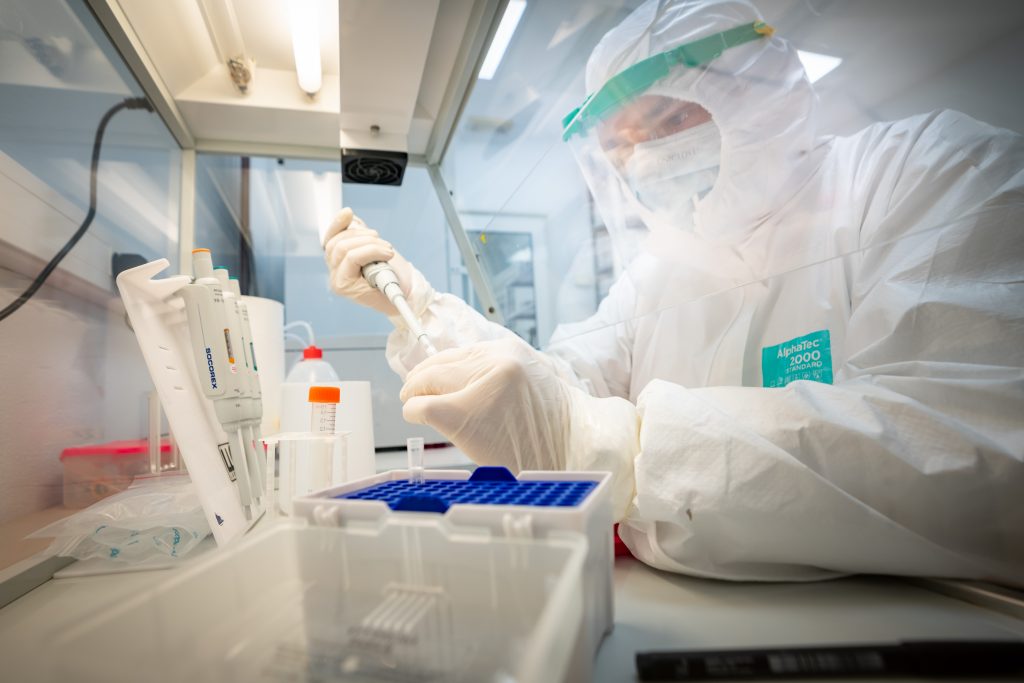
To answer this question, the scientific team analysed ancient DNA preserved in the feathers. ARAID researcher Pere Bover, head of the IUCA Paleogenomics Laboratory and co-author of the study, led the phylogenetic analysis of the remains:
“From the paleogenomics perspective, we extracted DNA from the samples, prepared sequencing libraries that allow us to identify and sequence the genetic material, and reconstructed the mitochondrial genome. This genome is more abundant than nuclear DNA, easier to obtain, and contains phylogenetic information. Analysing it allows us to identify the species and their evolutionary relationships,” explains Bover.
Sequencing data and phylogenetic analyses identified several species of Amazonian parrots, including scarlet macaws (Ara macao), red-and-green macaws (Ara chloropterus), blue-and-yellow macaws (Ara ararauna), mealy parrots (Amazona farinosa), and also a gull. These analyses provide preliminary hypotheses about the origin of the individuals. Genetic data revealed a high level of genetic diversity, a pattern consistent with birds captured from wild populations rather than animals bred for generations in captivity.
The team also analysed the carbon and nitrogen isotopic composition of the feathers, a technique that allows researchers to reconstruct the diet of animals during the period when the feathers grew. Chemical signatures showed that the birds had consumed maize, a food that is not part of the natural diet of macaws in the Amazon rainforest. This suggests that the animals were kept in captivity for some time after capture.
“Modern birds from the tropical rainforest had a chemical signature reflecting a wild diet typical of that environment. However, the ancient feathers found in the coastal desert tomb had a completely different signature,” Bover explained in statements to the SINC science news agency.
Taken together, the evidence suggests that the birds were not simply hunted for their feathers, but rather transported alive from the Amazon to coastal regions, where they remained long enough to grow new feathers under a different dietary regime.
Possible routes across the Andes
In pre-Hispanic Andean societies, tropical bird feathers held strong symbolic and ritual value. They were used in ornaments associated with funerary contexts and individuals of high status. Their presence in some burials at the Pachacamac complex suggests that their possession was linked to prestige and the representation of power within these societies.
Transporting live macaws would have posed a significant logistical challenge, requiring the crossing of vast distances and dramatic altitude changes from the tropical rainforest to the Pacific coast.
To explore how this transfer might have taken place, the researchers applied landscape mobility models, incorporating topography, river networks and known archaeological centres. The results identified potential corridors that could have facilitated transport between the Amazon and the Andean coast.
According to the authors, these findings are consistent with the existence of long-distance interaction and exchange networks connecting different ecological regions of the Andes prior to the Inca period.
Article reference:
Olah, G., Bover, P., Llamas, B. et al. Ancient DNA and spatial modeling reveal a pre-Inca trans-Andean parrot trade. Nat Commun 17, 2117 (2026). https://doi.org/10.1038/s41467-026-69167-9
Video abstract del artículo: https://youtu.be/Vb5eoTaGLO0?si=z2UfO9ag2hEU6Tf9